
Sacred Heart Catholic Primary School

English and Phonics
Reading
Intent
At Sacred Heart Catholic Primary School and Nursery, the teaching of reading is at the very core of our curriculum. It is our intention to ensure that, by the end of their primary education, all pupils are able to read fluently, and with confidence, in order to be able to access any subject in their secondary education and beyond.
We want children to establish an appreciation and love of reading at all stages of their learning journey. We are committed to providing a broad and diverse range of texts and books which are rich in vocabulary. We want our children to be inspired by a wide range of text types and diverse themes, as well as a range of authors and poets, and exposed to a balance of new and classic literature – all to create a living library inside the child’s minds which will give them a good grounding for independent reading in the future.
We, therefore, encourage all pupils to read regularly and widely, using both fiction and non-fiction texts to:
· Develop knowledge of themselves and the diverse world in which they live;
· Establish an appreciation and love of reading;
· Gain knowledge across the curriculum;
· Develop their comprehension skills;
· Develop their self-awareness to understand the kind of reader they are.
We will support all children to learn to read through consistent teaching and learning approaches, clear leadership, regular monitoring and assessment along with a joint commitment between school and home.
Implementation
To provide children with a solid start to learning to read, the systematic teaching of phonics is given the highest priority, and plays a central role in our reading curriculum, particularly in Early Years and Key Stage 1.
PHONICS
At Sacred Heart School, we use a synthetic phonics programme called ‘Read Write Inc. Phonics’.
We have an agreed progression for the teaching of new phonic sounds and use the Read Write Inc. phonics scheme to support this. During phonics sessions, our staff teach children the relationship between sounds and the written spelling patterns (or graphemes) that represent them. Phonics sessions involve pupils reading aloud in order to apply and consolidate their phonics knowledge and skills, with the primary aim of learning to read with fluency. Partner work is very important: pupils often work together, so, teamwork is a key part of RWI Phonics sessions. All children in Reception, Key Stage 1 and, where necessary, Key Stage 2, have daily phonics sessions in small ability-based groups which are matched to their current needs and phonics skills.
We re-assess children every half term so we can place them in a phonics group where they will make the most progress.
Timely intervention is planned for those children who are working below expected levels as soon as their needs are identified: we want all children to be able to ‘keep up’ and not have to ‘catch up’. One-to-one or small group sessions may be provided for some children for this purpose. Staff may also use ‘Pinny Time’ to revisit key sounds/words at incidental points throughout the day in Reception and Key Stage 1.
We recognise that systematic, high quality phonics teaching is essential, but additional skills and opportunities are needed for children to achieve the goal of being a well-rounded reader, namely understanding what is read, or ‘reading comprehension’. At all phases, phonics teaching and learning is complemented with whole class reading which extends the focus of decoding and ‘reading with fluency’, as well as developing other reading comprehension skills: vocabulary, inference, prediction, explanations, retrieval and summarising/sequencing. The reading curriculum is informed by Key Stage 1/2 National Curriculum objectives and Reading Content Domains, which are built upon systematically through school.
With our youngest children in the Nursery class, there is a daily planned activity to develop vital speaking and listening skills and phonological awareness (Phase one phonics activities are planned and delivered). Throughout the day, in our Nursery class, back and forth conversations and sharing of stories and rhymes are used to develop individual children's attention, understanding and spoken language with a strong emphasis on extending vocabulary. From the summer term, Nursery pupils (who are due to move into Reception in the following autumn term) are taught systematic phonics.
During the summer term in Year 1, pupils undertake a national Phonics Screening Test which assesses their ability to apply what they have learnt. Pupils who do not pass their Year 1 Phonics Screening Test continue to have intervention to support the acquisition of these key skills and are retested in the summer term in Year 2.
Pupils usually complete the Read Write Inc. Phonics programme by Year 2: some may even finish towards the end of Year 1. Pupils in Lower Key Stage 2 who need extra support with decoding may also follow the phonics programme. For older learners, RWI Fresh Start is used to support vulnerable learners in KS2. When pupils have completed the Read Write Inc. Programme, and have gained the necessary level of achievement in phonics, lessons move towards whole-class reading lessons where the teaching and learning is increasingly focused on reading comprehension skills.
WHOLE-CLASS READING (using VIPERS)
When children have completed the Read, Write, Inc. phonics programme, reading skills are taught and developed during whole-class daily reading sessions, using focused skill teaching and high-quality texts.
In whole-class reading sessions, children continue to read aloud to develop their decoding and ‘reading with fluency’ skills and strategies, building upon their phonics knowledge and skills. Whole-class reading provision is informed by Key Stage 1/2 National Curriculum objectives and Reading Content Domains of the curriculum, which are delivered systematically through the school’s reading curriculum. We use an approach called ‘VIPERS’ as a way to help children understand the content domains of the curriculum and their purpose – with a focus on the types of questions which they need to answer for effective reading comprehension skills.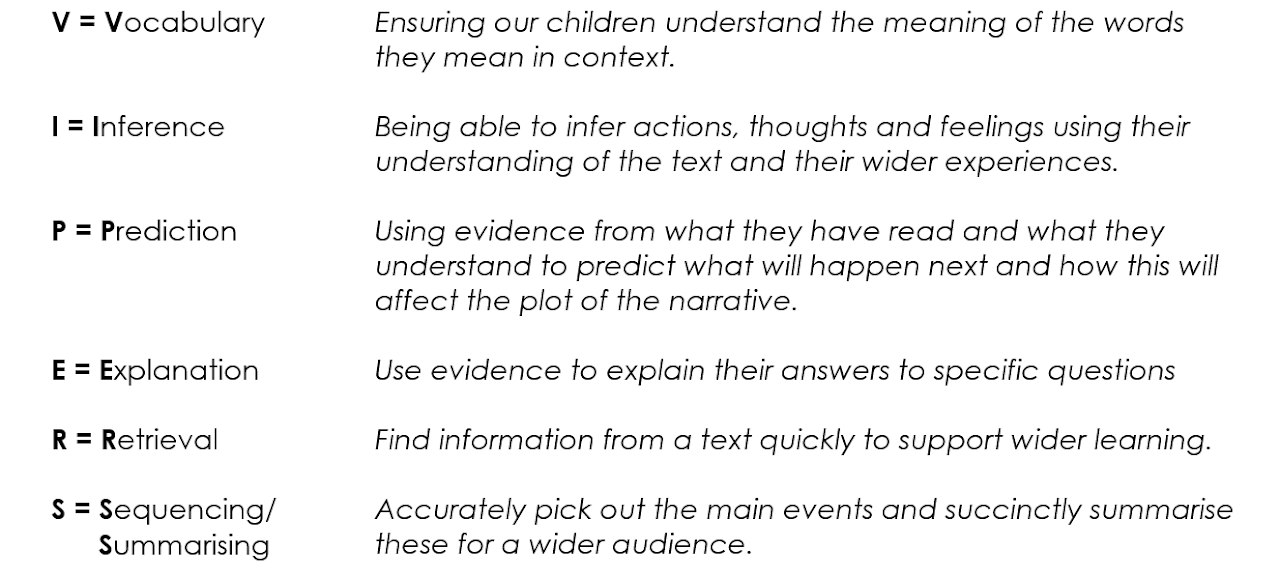
We use Reading Spy characters to embed the VIPERS concept and help make this fun for children: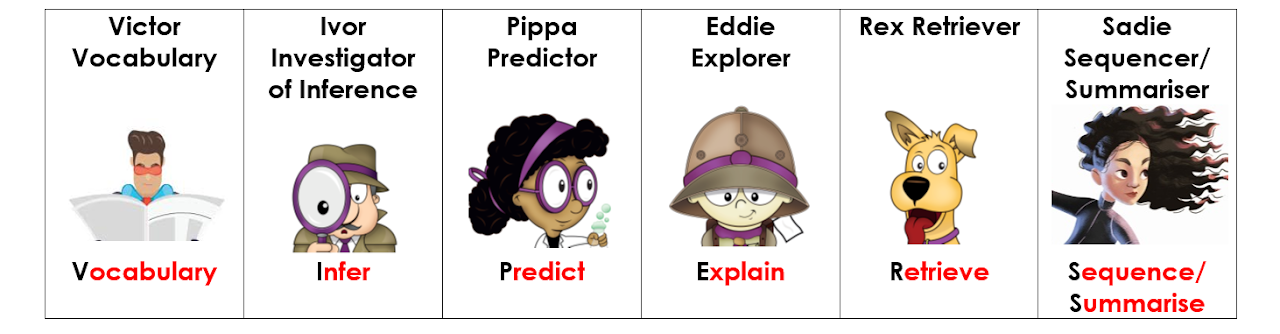
In whole-class reading sessions, the class teacher models how to read aloud, and respond to the texts in a variety of ways, deploying and range of reading comprehension VIPERS strategies. Pupils are encouraged to engage in independent, paired, echo and choral reading, share ideas and engage in reading comprehension tasks, using a range of age-appropriate texts.
Class teachers draw upon careful observations and continuous assessment to ensure children are challenged and to identify children who may need additional support, with decoding, fluency and/or reading comprehension. Timely intervention is planned for those children working below expected levels as soon as their needs are identified.
In addition, some pupils may read, and/or receive further intervention focusing on reading comprehension, with a teacher, teaching assistant or reading volunteer. The focus is pupils whose attainment falls into the lowest 20% nationally (those below age-related expectations). Furthermore, Pupil Premium children and those pupils not reading regularly at home, have additional opportunities to read aloud.
We recognise the importance of developing a rich and extensive bank of vocabulary; therefore, we explicitly teach vocabulary directly linked to the text during every phonics and whole-class reading session. This is revisited and reinforced across sequences of sessions, ensuring that new vocabulary is embedded.
All classes also use class books for ‘reading for pleasure’, to excite and engage the children, to expose them to new and varied vocabulary, or as a stimulus and to support learning across the curriculum.
READING AT HOME
Reading at home is also encouraged and promoted through class incentives and parental engagement sessions.
Children working on the Read Write Inc. programme take home a Read Write Inc. Ditty Sheet / ‘book bag book’ matched directly to their current phonics level. The book bag books include many of the same reading activities that we use in class and include parent guidance. Pupils should be able to share the Ditty Sheet/ book bag book confidently and fluently, reading with some expression or a ‘storyteller voice’ – as they will have read the book in school (sometimes, several times) before taking it home for extra practice. Parents/carers are assured that the ease in which pupils can read their Ditty Sheets/book bag books does not mean that these are ‘too easy’ – we want children to feel confident and look forward to sharing their reading with someone at home. Children enjoy re-reading stories they know well. Their speed, fluency and understanding improve on every read. Pupils working on the Read Write Inc programme also take home a Book to Share ‘Book Band’ book to share with an adult at home. These books will be chosen from our structured ‘Book Band’ library, which is made up of a variety of schemes including Oxford Reading Tree, Collins Big Cat, amongst others. These books may contain sounds and words that your child has not yet come across in their phonics sessions and cannot be read independently; this is why these books should be read with the support of an adult.
We make sure that pupils can read, with fluency, the full scheme of Read Write Inc. Phonics story books before they progress onto our school Book Band scheme.
When children have completed the Read Write Inc. phonics programme, children will take home Book Band books, which are in line with their current level of reading skill, and which will stretch their reading comprehension.
We recommend that children, who are taking home Book Band books, read at home for at least 20 minutes a night. Even when children can read to themselves, they still love to read aloud to another person – this also enables them to practise tone and expression when reading.
Monitoring of reading diaries is carried out by teachers to check for regular reading and to give praise and class incentives in order to promote the uptake with home reading and pupil/parental engagement.
Story-time and Reading for Pleasure
The sharing of stories and books is also central to our provision throughout the school, so children enjoy both reading and being read to as part of our daily timetable.
We aim to provide many opportunities where pupils can listen to stories/texts or read independently in a quiet and reflective environment. We have a bank of stories, poems and other texts which are not only used as a stimulus or curricular-link within lessons but are used to discuss feelings, familiar situations, different cultures, current issues or read just for fun. Class texts also provide children with the opportunity to respond to the text using skills from wider teaching and learning.
Our class books are selected carefully to reflect the diverse cultures of our school community so that pupils feel appropriately represented. Our book choices are chosen to excite and engage the children as well as expose them to new and varied vocabulary. All books shared with the children are age-appropriate and updated as new resources are available or recommended. We have an agreed set of key class books/texts to be covered across the school but recognise that teachers and pupils in different year groups will have personal preferences which can be just as inspiring to share.
Every class has their own class library area.
Impact
Through the teaching of systematic phonics, our aim is for children to become fluent readers by the end of Key Stage 1. With decoding taught as the initial prime approach to reading, pupils will become familiar with this strategy and have the confidence to work out unfamiliar words in any new texts they encounter even when they have come to the end of the Read Write Inc. programme. Pupils will have the opportunity to develop their fluency and comprehension as they move through the school, accessing a wide range of texts during lessons and well as independently.
Attainment in reading is measured using statutory assessments such as the end of EYFS, Key Stage 1 and 2 assessments and following the outcomes in the Year 1 Phonics Screening check. Additionally, we track our own reading progress and attainment through the use of RWI half-termly and book-bag screening assessments, book band Running Record screening assessments, Accelerated Reader termly assessment, NFER reading papers, and on-going teacher assessment.
More importantly, we believe that reading is the key to unlocking all learning; therefore, the impact of our reading curriculum goes beyond statutory assessments. We give all the children the opportunity to enter the amazing new worlds that a book opens up to them and share texts from a range of cultures or genres to inspire them to question or seek out more for themselves. We want reading to be the golden thread running through a child’s journey at Sacred Heart School. When they leave us, we want pupils to possess the reading skills and love of literature which will help them to enjoy and access any aspects of learning they encounter in the future.
Writing
Intent
At Sacred Heart Catholic Primary School and Nursery, we endeavour to create a love for writing.
We want every child to leave Year 6 with the skills of an excellent writer who:
· Has the ability to write with fluency;
· Has an extensive bank of vocabulary and an knowledge of writing techniques to extend details or description;
· Can structure and organise their writing to suit the genre they are writing and include a variety of sentence structures;
· Displays good transcription skills that ensure their writing is well presented, punctuated, spelled correctly and neat;
· Can think about the impact they want their writing to have on the reader and knows how they will achieve this;
· Re-reads, edits and improves their writing so every piece of writing they produce is to the best of their ability.
We understand that writing is complex and is made up of many skills and that each of these skills requires specific teaching. The link between speaking and writing is a strong element of our practice and we know that ‘if children can’t speak it, they can’t write it’. Spoken language and oracy is prioritised in our writing curriculum in order to build vocabulary for all learners and prepare our children with the tools they need in order to be successful in their writing. Words are powerful – using the right words makes for better communication and effect. Vocabulary and the use of language are taught explicitly within and across the writing process and are also unpicked in its daily use in the classroom.
Our school also strongly believes in the importance of teaching children not only to have the skills to write, but to enjoy and feel motivated to write too. We try to make writing ‘real’ and purposeful for the children through exciting hooks and interesting writing opportunities and activities, which often link to cross-curricular topic or high-quality text. Through this approach, we intend for children to develop a love of writing that they will carry with them throughout their school life and beyond.
Implementation
We ensure each unit of writing is carefully and effectively planned for, responsive to learners’ needs and interests, incorporates all the key elements needed to be a successful writer, as well as ensuring coverage of National Curriculum expectations and the progression of skills.
To ensure we have an agreed whole-school approach to the teaching of writing, we use the teaching sequence as outlined in the diagram below. This provides a coherent model for linking and combining language and literacy knowledge into effective teaching and learning opportunities. This leads to meaningful and high-quality written outcomes, with each phase in a teaching sequence informing and leading into the next.
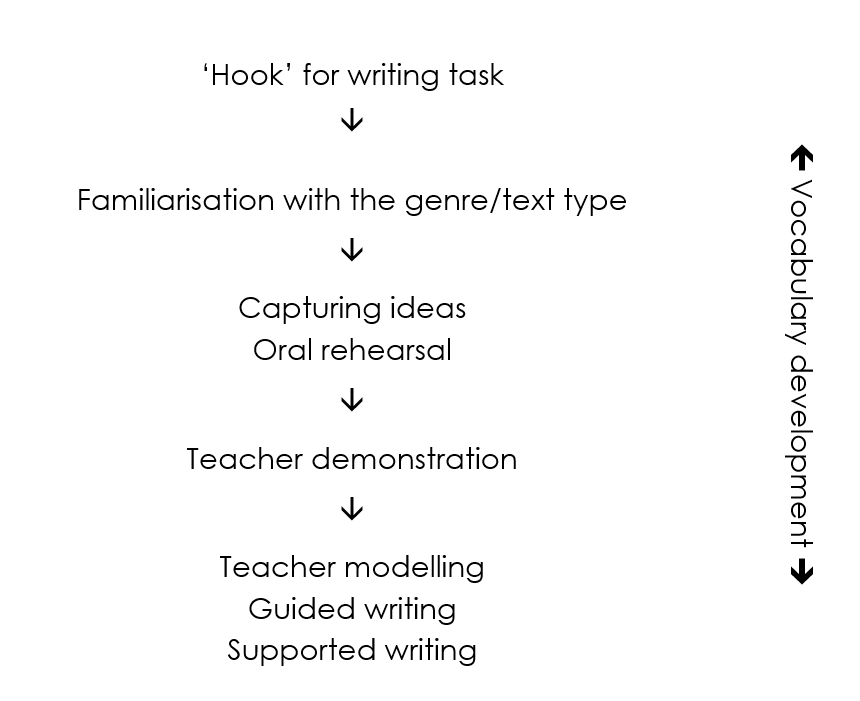
Each unit of writing starts with a ‘hook’–something exciting that will engage the children with the subject matter. The hook is intended to excite children into the topic, make them want to find out more! Through the hook, the purpose and audience for the writing task is also established. Where possible, the context for writing is carefully chosen to match and align with the wider curriculum and year group’s topics.
Children will then be immersed in creative activities and discussion to develop their background knowledge and ideas for writing, grammatical knowledge and vocabulary aligned to the text. ‘Speaking and Listening’ activities are crucial to developing children’s vocabulary and interaction with the subject matter. These will include drama, debates, storytelling and research, and will be a regular feature from the beginning, and across, a writing unit.
A model text is used to expose pupils to the text type: all English writing units stem from a well-structured and high-quality WAGOLL (what a good one looks like), which allows children to experience an example of the language and overall organisational features associated with the chosen text type. The model text is used to provide a stimulus for in-depth discussions around the underlying patterns of the text type, and how the writer creates different effects focussing heavily on sentence structures and vocabulary.
Children are taught to plan their writing and we use a variety of planning writing templates across the school. This may be informal in Key Stage 1 (through story maps, drawings, etc.), moving on to more formal planning templates as they move through Key Stage 2.
Teachers model the planning, writing and editing process, maintaining a clear focus on key objective(s). Teachers think the writing process through aloud, rehearsing sentences before writing, re-reading and editing constantly, making changes to sentence-construction or word choice and explaining why one form or word is preferable to another. Children also make contributions based on initial modelling, with contributions and their merits being discussed and refined. The shared writing session primarily focuses on how to achieve a given objective(s) within the writing to be completed. It also provides a vehicle for the teaching of grammar. Children then have the opportunity to practise and extend their own writing. Opportunities are provided for practise until most children have mastered the objective and can apply it when they write.
In independent writing sessions, the children create their own piece of writing, sharing their writing with a partner and exploring suggestions for improvements. As the children write, they continue to orally rehearse, making changes where necessary. During this time, children are expected to edit their work carefully, considering their teacher’s feedback and the effect their word choice has on the reader. Finally, the children write the text-type independently and apply what they have learnt across the curriculum. Children are encouraged to edit for publishing. The unit ends with a writing outcome that is assessed by the teacher. Where possible, feedback is completed within the lesson, unless children have completed a key writing piece when a ‘deep mark’ is completed. All feedback is given in line with our marking and feedback policy. Children should be clear on what they can do well and what they need to improve within their writing.
High quality working walls are used during lessons to enhance learning and for children to refer to. Working walls display an array of teacher modelled writing, the shared writing with children and children’s published work providing good quality scaffolds for all abilities.
Spelling:
In addition to the teaching of spelling within the teaching sequence and the focus on the development of high quality synthetic phonics, a whole-school approach to the teaching of spelling has been developed. Spelling is taught according to the rules and words contained in Appendix 1 of the English National Curriculum. Children are given spellings to learn each week and are given a spelling test the following week.
Grammar and Punctuation:
Grammar and punctuation knowledge are taught primarily through English lessons. Teachers plan to teach the required knowledge through the genres of writing that they are teaching, linking it to the genre to make it more connected with the intended writing outcome. Teachers sometimes focus on particular grammar and punctuation knowledge as stand-alone lessons, particularly when focussing on identification of specific elements.
Assessment:
We use a range of strategies to assess the children’s writing and employ effective formative and summative assessment procedures at the beginning, during and at the end of a unit of work. Before a unit of work begins, class teachers consider and establish the skills pupils already have to apply within a particular text type or genre and this information is then used to inform the planning of the unit of work. The unit ends with a writing outcome and assessed to evaluate the knowledge pupils have developed and acquired and the progress they have made.
Teachers and leaders work together to jointly standardise and moderate the children’s writing. Summative assessments for writing are then submitted to the senior leaders at the end of each term. Writing assessment grids have been developed for the following year groups: Y1, 3, 4 and 5. Teachers refer to these alongside the standard Teacher Assessment Frameworks (TAFs) for Year 2 and 6 as a support for making judgements and to inform planning. Teachers will use their professional judgement to determine whether a child is working within age-related expectations, above or below. They base their judgements on the quality of the writing that children produce across a collection of writing.
Children who are identified as not achieving age-related outcomes and/or those on the SEND register may be assessed against the outcomes for the year group below. Interventions/support may be put in place in order to accelerate writing skills in this case. The nature of the intervention will be decided by the teacher and the SENCo. Support in class may include small group work with an adult during lessons to model key skills, scaffolds created by the teacher to assist with completion of work and word banks/sentence openers provided to assist the child when writing.
Impact
We aim to meet the expectations of the Early Learning Goals and the National Curriculum and when possible, exceed these and ensure that children make good progress in Writing during their time at Sacred Heart Catholic Primary School and Nursery.
By the time the children reach the end of our writing curriculum in Year 6, the impact is that they have the knowledge and skills to be able to write successfully for a purpose and audience. They will have developed a writer’s craft, enjoy sustained writing and can manipulate language, grammar and punctuation to create effect.
We are ambitious for all our children and strive to ensure that we provide all children with the skills needed for them to become successful writers, no matter what their starting point, background or additional needs.
Phonics
Intent
At Sacred Heart Catholic Primary School, we value reading as a key life skill and are dedicated to enabling our pupils to become lifelong readers. Reading opens the door to wider learning. We believe that reading is central for academic success and progress across the curriculum; therefore, we provide our pupils with the skills and confidence to deal with printed language from a very early age. We provide children with a structured scheme for learning in Phonics and Early Reading – Read Write Inc. Our aim is that children become fluent and confident readers so that, at the end of their primary education with us, they are able to read a wide variety of texts easily.
As we hold reading for pleasure at the heart of reading, we ensure children develop a real love and thirst for reading widely, across a range of text genres, by providing them with a range of books. Read Write Inc. story books are used when reading in class and Phonics groups. Read Write Inc. bag books are used for practising reading skills at home. Both Read Write Inc. books (those used in school and those sent home) match the individual child’s phonic ability. This enables pupils to practise at home what they have learnt in school, building on their confidence and fluency as readers.
We, as a school, are determined to provide the best phonics teaching to our children and therefore ensure all staff members teaching Read, Write, Inc. sessions are regularly up-to-date with the correct training. We also ensure our parents and carers are kept up-to-date too by providing workshops, and sharing Read Write Inc. resources and information, alongside providing ‘how-to’ videos so that parents/carers can understand how to best support their children at home.
Implementation
Read, Write, Inc. Phonics
At Sacred Heart School, we use the Read Write Inc. (RWI) scheme to get children off to a flying start with their Phonics and Reading.
Reading
When using RWI to read, the children will:
-
Learn 44 sounds and the corresponding letter/letter groups using simple prompts
-
Learn to read words using sound blending (Fred talk)
-
Read lively stories featuring words they have learnt to sound out
-
Show that they comprehend the stories by answering ‘Find It’ and ‘Prove It’
Writing
When using RWI to write, the children will:
-
Learn to write the letter/letter groups which represent the 44 sounds
-
Learn to write words by saying the sounds and graphemes (Fred fingers)
Talking
When using RWI, the children will also work in pairs:
-
To answer questions
-
To take turns talking and listening to each other
-
To give positive praise to each other
Reading Books / Ditty Sheets sent home – Foundation Stage and Key Stage 1
Pupils will take home RWI Ditty Sheets / Book Bag books to practise their early reading skills, using their knowledge and skills in Phonics at home. Their Ditty Sheet / Book Bag book will align with what they have learnt during their Read Write Inc. phonics sessions. This means that their Ditty Sheet/book will contain sounds and words they have already been taught in school, so, at home they can practise these confidently. 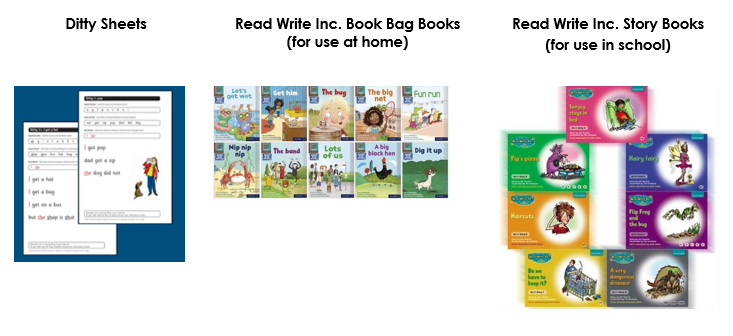
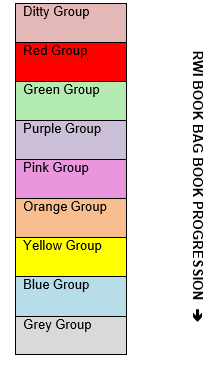
Reading book progression
Children in Foundation Stage, who know all (Set 1) single letter sounds speedily and can blend sounds into words orally, will bring home Ditty Sheets or a Red Ditty Book Bag book to share at home – these sheets/books align with the phonics they have been learning in their RWI group in school.
Pupils will progress through the RWI book levels at their own speed.
Parents/carers can find more information about our phonics scheme, and how to support phonics learning and early reading at home, at the following links:
https://www.ruthmiskin.com/en/find-out-more/parents/
Watch our parent tutorials to learn all about how to support your child as they learn with Read Write Inc. Phonics, with detailed ideas and advice on pronouncing pure sounds, blending, and digraphs.
Understanding Phonics
Pronunciation Guide
Teaching a Set 1 Sound
Independent Blending
Two letters, one sound
Teaching Blending